English 134 Mixed Genre Portfolio

A multi-genre exploration of my relationship with friendship, place, and perspective.

Cover Letter

In this portfolio, I return to the question that sat quietly underneath my Sequence II profile essay: Why do our emotions so often fail to match the spaces we inhabit, and how do the people closest to us reshape what we see? In “Perspective and Friendship: How They Color Our Environment,” I wrote about a morning in Grindelwald, Switzerland—a place defined by extraordinary beauty—yet I carried heaviness that didn’t belong to the landscape around me. Even as hikers laughed and sunlight spilled across the valley, I felt distant, tired, and out of sync with the world. What changed the meaning of that place for me wasn’t the scenery; it was my best friend, Fletcher, whose presence grounded me and helped me understand that perspective is never fixed. It shifts, bends, and brightens depending on who walks beside us. This tension—between outer landscapes and inner states, between the seen and the felt—became the foundation for this multi-genre project.

Across the quarter, I’ve been drawn to writing that blends environment, emotion, and relationship. My earlier pieces explored memory, self-overcoming, and the quiet spaces where identity takes shape. When I revisited these writings, I realized they share a core question: how do we come to understand ourselves through the presence of others? The portfolio expands that question across several genres, each one offering a new angle that a single essay couldn’t express on its own. The formal letter allowed me to speak directly to Fletcher, the person whose perspective changed my understanding of that moment in Grindelwald. Shifting from analysis to direct address pushed me to consider how ethos, pathos, and kairos work differently when writing to someone I know deeply—not to persuade him of an argument, but to acknowledge a truth he helped me see.

The new text—a reflective, photo-collage essay—approaches my central question from a broader lens, connecting my personal experience to research about perception and relationships. Writing in this genre opened space for a more conversational voice, one that bridges academic ideas with lived experience. It gave me room to explore why emotions sometimes misalign with our surroundings and how friendship functions as a kind of internal compass. Integrating new sources helped me better understand the science behind what I felt intuitively that day in Switzerland: that humans don’t perceive place objectively, but through relational meaning.

The photographs included earlier in the portfolio add another dimension, one that words alone can’t fully capture. In the black-and-white horse portrait and the wide-open landscape with a rider in motion, I found visual metaphors for stillness, constraint, freedom, and perspective—themes deeply connected to my profile essay. Images slow the reader down. They allow a moment of contemplation before returning to text, mirroring the way reflection happens in real life: quietly, gradually, and often without our noticing. These photos create emotional texture, showing what it feels like when someone helps you see the world differently.

Finally, the texts by other authors broadened the conversation beyond my own perspective. Their work offered new language, new images, and new contradictions that deepened my understanding of how relationships and environments interact. Instead of functioning as examples, these texts became partners in inquiry—voices that pushed me to see my topic with greater complexity.

By placing all these pieces together, I began to see that my original question wasn’t only about that morning in Grindelwald. It was about the larger human experience of navigating inner landscapes that don’t always match our outer ones, and how friendship has the power to bridge that gap. This portfolio made me look more closely at the subtle ways people influence our perception—how a place becomes a memory because of who stood beside us, and how even the “wrong emotions” can become meaningful when shared. Creating these pieces reminded me that writing is not just a record of experience; it is a way of re-seeing it. And sometimes, through the act of returning to a moment, we discover that its meaning has been waiting for us all along.

Formal Letter

To: Fletcher [Last Name]

From: Teague Shepard

Subject: How Your Friendship Reshaped My Perspective

San Luis Obispo, CA

December 2025

Dear Fletcher,

I’ve been thinking a lot about the morning we spent in Grindelwald—how the air felt thin and clean, how the mountains rose like something holy, and how every person around us seemed lit up by the sunlight on the valley. When I look back on that day, the photos show a world that looks peaceful, almost impossibly beautiful. But the truth you never saw is that my inner world didn’t match the image at all. I was weighed down in ways I didn’t have words for at the time, carrying stress, tension, and heaviness that felt out of place in a place like that. The landscape was glowing, and I felt dim.

I didn’t understand it then, but I think I do now: perspective isn’t built from scenery alone. It’s shaped—constantly, quietly—by the people we trust. And that morning, without meaning to, you shifted mine.

I remember watching you and my brother laugh on the trail, the two of you completely alive in the moment, and thinking how strange it was that I couldn’t feel what you were feeling. Even the warmth of the sun felt distant to me. But when we sat down facing the mountains, something changed. You didn’t say much—honestly, you probably weren’t trying to “help” in any conscious way—but just being there with you made the world feel a little less sharp. Your presence softened the edges of the day. The tension I had been holding onto loosened, not because the place changed, but because I wasn’t carrying myself through it alone.

That’s something I’ve learned from you more times than I can count: friendship is its own kind of space. It’s a lens that clarifies things when everything feels out of focus. It’s a reminder that even when our emotions don’t align with our environment, even when we feel the “wrong thing” in the “right place,” someone else can stand beside us and help us see differently. I didn’t understand that at seventeen, but I do now. And I’m writing to tell you how grateful I am.

I compared us once—half-jokingly—to Frodo and Sam, and I know that sounds dramatic. But the older I get, the more accurate it feels. Sam didn’t fix the weight Frodo carried; he didn’t erase the danger or the fear. He simply walked beside him, steady and loyal, until the path made sense again. That’s what your friendship has been for me. When I’ve been tired, you’ve been grounding. When my perspective has narrowed, you’ve widened it without forcing anything. When I’ve been quiet or confused or caught in my thoughts, you’ve been the one who makes space feel breathable again.

What I’m trying to say is this: I see now how much of my world has been shaped by the way you move through it. And I don’t think I’ve ever really thanked you for that.

I’m not writing this letter to make some dramatic claim or ask anything from you. I’m writing because the assignment for this project asked me to consider a stakeholder—a person whose perspective could be affected by my words. And when I thought about perspective, yours was the first that came to mind. Not because you need convincing, but because our friendship has become such a clear example of how human connection shifts the meaning of a place, a moment, or even a memory.

Grindelwald was beautiful on its own, but you’re the reason it became meaningful. You’re the reason the photos feel warm rather than hollow. You’re the reason I look back on that morning not as a time when I felt out of sync with myself, but as a moment when someone I care about unknowingly helped me find my footing again.

Thank you for that—and for all the times since when you’ve done the same. I don’t think perspective is something we ever figure out fully, but I’m glad I get to keep learning it with a friend who makes the world feel a little lighter.

Sincerely,
Teague

New Text

Light, Motion, and the Company We Keep

Genre: Photo Collage Essay · Audience: classmates and general readers interested in perspective and place · Purpose: to explore how friendship reshapes our perception of animals, landscapes, and ourselves

Over Thanksgiving break, Ty and I drove out to Potrero Ranch in Dos Vientos with our cameras tossed in the backseat and no real plan except to see what the early winter light would give us. The ranch sits between rolling hills that look soft from a distance and sharp up close, the kind of landscape that changes character depending on who you’re standing beside. I didn’t know it then, but the morning would echo the same question I explored in my earlier writing: how does friendship shift the way we see the world? And what happens when we return to a place alone?

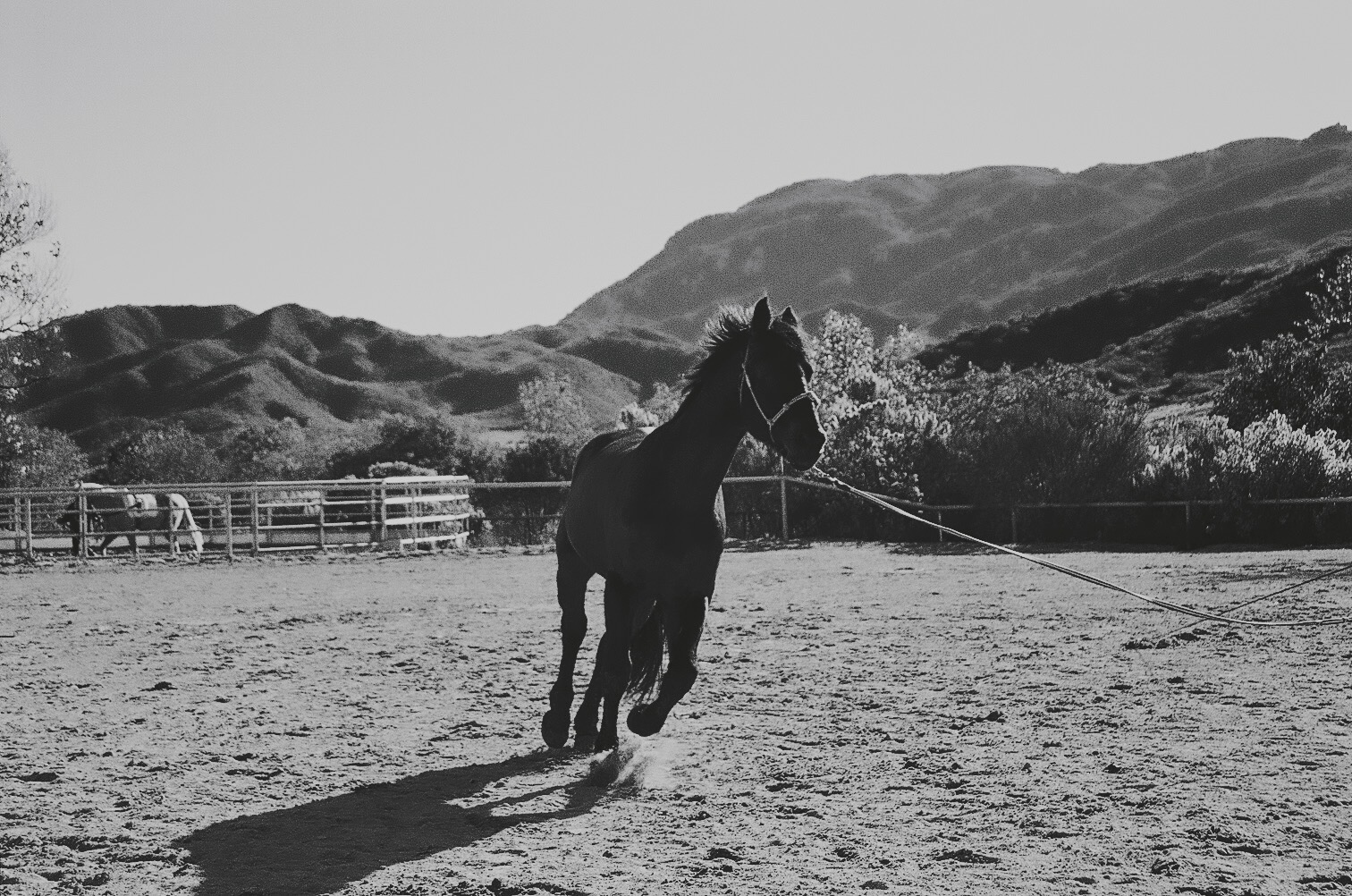
The first photo in this collage wasn’t taken by me at all—it was taken by Ty. His image freezes a horse mid-stride, dust rising beneath its hooves as if the ground itself is reacting to its motion. The rope extending out of the frame hints at a human presence, yet the horse’s body fills the image like something entirely unto itself, powerful and uncontained. Ty has a way of capturing animals with a kind of generosity, letting them take up space without interruption. When he showed me the photo on his camera screen, I remember feeling like he had seen something I had missed, even though we were standing in the same place. That small difference—his angle, his timing, his eye—became the first reminder that perspective is never solitary. We borrow it from the people beside us.

Researchers in cognitive science describe something similar as a form of joint attention: our understanding of a scene changes when we experience it with another person. Studies on shared perception suggest that humans naturally align their focus, emotion, and interpretation with the people around them, especially when they are looking at the same thing (Richardson et al.). I didn’t need the research to know this was true. Ty’s presence that morning sharpened my attention, made the horses seem more expressive, and made the landscape feel alive in a way it hadn’t before.

When I returned to the ranch alone a few days later, the light felt different. The hills seemed quieter. The horses were the same creatures, standing in the same pastures, yet something in me was less open, less attuned. That difference is visible in the first image I took that afternoon: a close-up of a speckled horse looking through a wooden gate, another horse blurred in the background. The focus on the eye creates a sense of inwardness, as if the horse is watching something I cannot see. Without Ty beside me, I found myself watching the horses more slowly, more cautiously, noticing details that required silence to perceive—the texture of fur, the flick of an ear, the breath gathering in the ribs.

Animal behavior researchers note that horses read human emotion with remarkable accuracy; they attune themselves to our tension, relaxation, and focus (Proops et al.). Standing there alone, I wondered if the horse sensed the difference in me too—the quiet, the introspection, the lack of shared laughter. In this way, the horse became both subject and mirror.

Later that afternoon, Anna rode out on Pompy, a steady Appaloosa whose coat looks like it was painted with light. Watching them move together across the field was entirely different from watching the horses at rest. Anna’s posture relaxed as Pompy picked up speed, her smile widening in a way that felt as instinctive as breathing. The photos I took of her don’t just show a rider and a horse—they show a relationship built on trust and timing. Pompy responds to her hands and body, and she adjusts in return, their movements leaning toward synchrony.

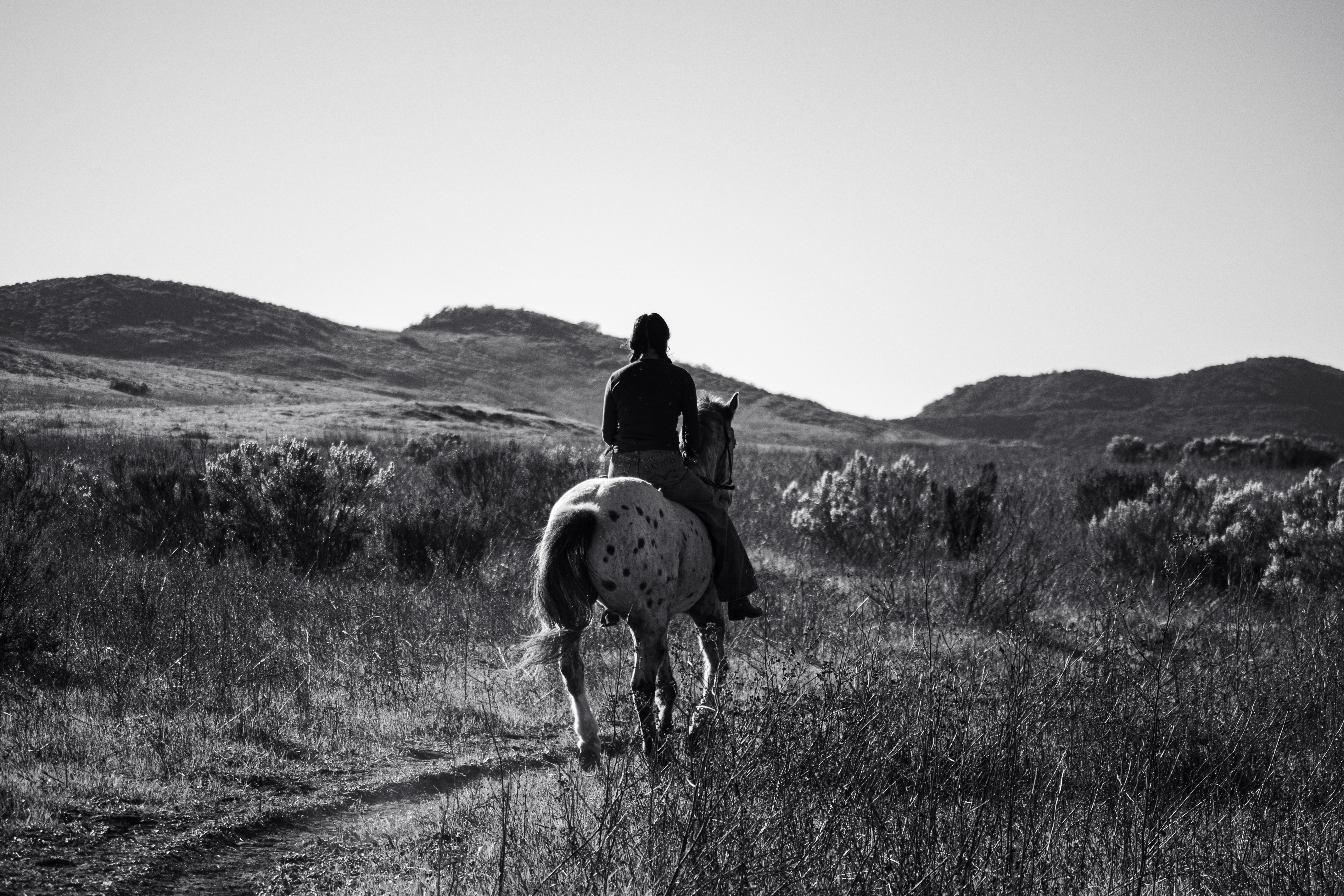
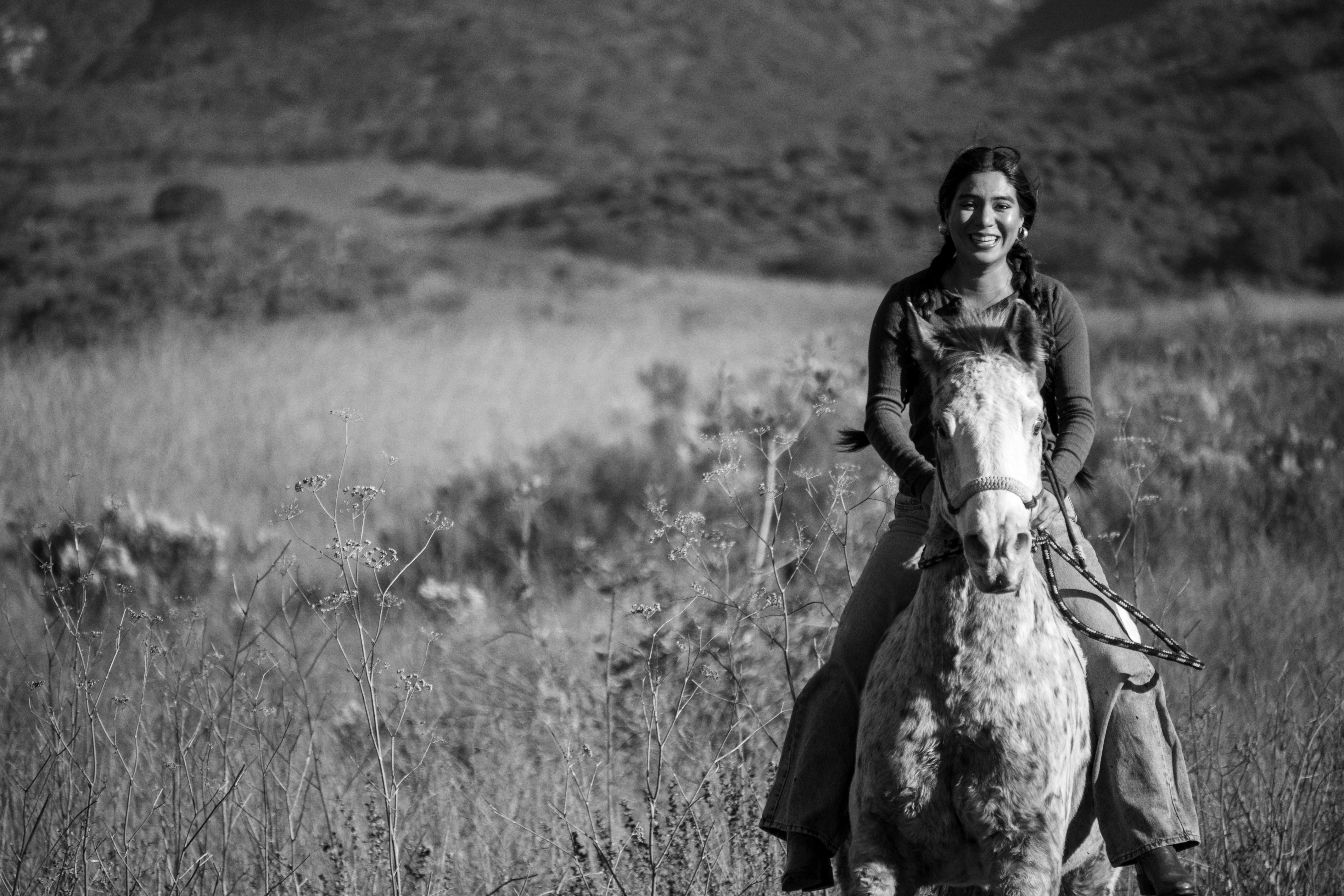
In one image, Anna rides straight toward the camera, Pompy’s ears forward, her braids swinging with each stride. In another, she and Pompy are small against the expanse of the hills, moving through the brush like a single shape. The farther they rode, the more I realized how different this moment felt from the morning with Ty. That day had been about shared observation; this one was about witnessing someone else’s connection, stepping back so that someone else’s relationship could fill the frame.

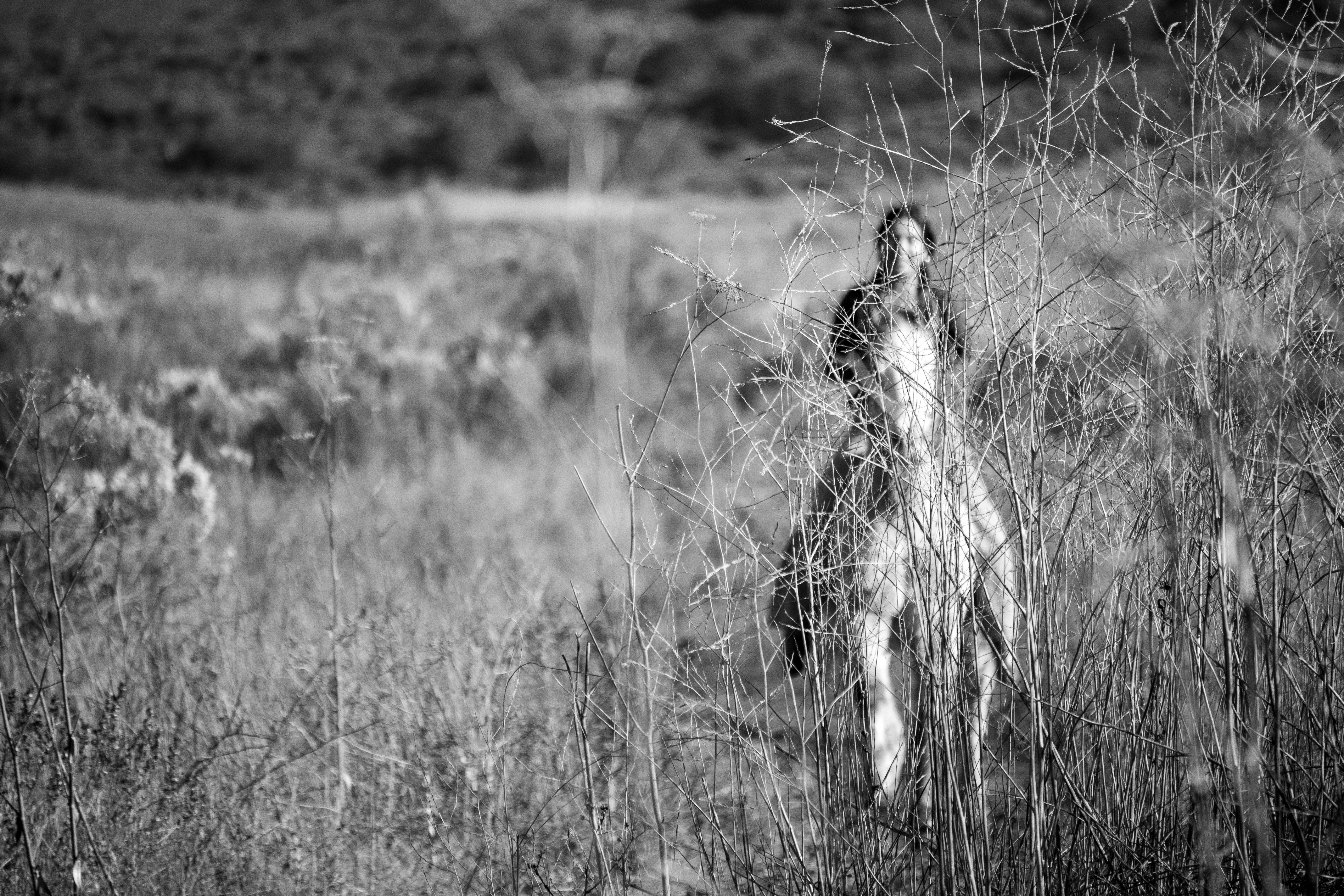
One of my favorite images from the day is the one where Anna and Pompy are partially obscured by tall, dried stalks. Her face is blurred, her outline softened, yet her presence is unmistakable. Something about that photo captures the feeling I’ve struggled to articulate across both this collage and my earlier writing: that we never fully see another person—not even someone we know well—but we can glimpse the outlines of who they are in the spaces they inhabit and the beings they connect with.

In Grindelwald, it was Fletcher who shifted the way the world felt. At Potrero Ranch, Ty and Anna did the same in their own ways. Friendship reframes our perception not by changing the world itself, but by changing us—lifting or softening or grounding something inside that we might not access alone. The horses, too, taught me something. Their movements echoed the fluidity of perspective: always adjusting, always responding, always negotiating space. Watching Ty photograph them, watching Anna ride, watching myself notice different things on different days—I realized that perspective is not a fixed point. It’s a shared rhythm we fall into with the people (and animals) around us.

This collage is my attempt to hold those rhythms still long enough to see them clearly.

Horse mid-stride in dust at Potrero Ranch, photographed by Tyler Ford

Photo 1 · Ty’s Perspective

Horse in Motion

Ty’s photograph freezes a horse mid-stride, dust kicking up beneath its hooves while the rope leading out of frame hints at a human presence just beyond what we see. The image captures both power and restraint, showing how another person’s eye can reveal details we might miss even when standing in the same place.

Close-up of speckled horse looking through a wooden gate at Potrero Ranch

Photo 2 · “Through the Gate”

Through the Gate

This close-up of a speckled horse looking through a wooden gate turns the ranch into an intimate, almost interior space. The horse’s eye becomes the focal point, reflecting curiosity and a kind of quiet awareness that mirrors the introspection of returning to the ranch alone.

Anna riding Pompy toward the camera at Potrero Ranch

Photo 3 · “Anna and Pompy, Approach”

Anna and Pompy, Approach

Anna rides Pompy straight toward the camera, her posture relaxed and her expression open. The movement of her braids and the forward set of Pompy’s ears capture the joy and trust between rider and horse, showing relationship as something dynamic and co-created.

Anna and Pompy riding across the hills at Potrero Ranch, small in the frame

Photo 4 · “Small Against the Hills”

Small Against the Hills

Here, Anna and Pompy appear small against the wide sweep of the hills, their figures partially swallowed by the landscape. The image emphasizes scale and distance, turning motion into a quiet kind of companionship moving through a much larger world.

Anna riding Pompy, partially obscured by tall dry grass at Potrero Ranch

Photo 5 · “In the Tall Grass”

In the Tall Grass

In this photograph, Anna and Pompy are partially obscured by tall, dried stalks of grass. Her face is softened and blurred, yet her presence is unmistakable. The image reflects how we often see people indirectly—through the spaces they inhabit and the beings they connect with.

Wide view of horse and rider moving through open space at Potrero Ranch

Photo 6 · Movement Through the Field

Movement Through the Field

This wider view of a horse and rider moving through the field links back to the portfolio’s broader visual language of motion, freedom, and open space. It echoes the earlier landscape photo while situating it within the specific relationships and memories of Potrero Ranch.

Other Authors’ Texts

“I Wandered Lonely as a Cloud” (excerpt)

Author: William Wordsworth · Genre: Poem

In this excerpt from Wordsworth’s iconic poem, perspective shifts not because the landscape changes, but because the speaker becomes aware of how companionship—even the imagined company of daffodils—reshapes emotion. The poem begins with isolation but transforms into a moment of shared presence, suggesting that one’s environment becomes meaningful only when it enters into relationship with something or someone else. The daffodils’ “jocund company” alters the speaker’s inner world, turning a solitary walk into an unexpected moment of emotional clarity.

Wordsworth’s insight parallels my experiences at Potrero Ranch and in Grindelwald: the world looks different depending on who is standing beside you—or who is absent. Ty’s presence illuminated details I might have missed, just as Anna’s partnership with Pompy revealed a kind of harmony I could only observe from the outside. Like the poem, these moments suggest that perspective is relational, and that beauty often becomes visible only through the lens of shared presence.

Excerpt from “Nature”

Author: Ralph Waldo Emerson · Genre: Prose Essay

In this passage from “Nature,” Emerson describes a moment of profound perceptual shift, where the boundaries between self and environment dissolve. His metaphor of becoming a “transparent eyeball” captures the unsettling but liberating experience of seeing the world without the usual filters of emotion, habit, or ego. Emerson suggests that true perception is not passive; it requires openness, relationship, and a willingness to be changed by what one encounters.

This idea resonates with the transitions in perspective I experienced while photographing at Potrero Ranch. With Ty beside me, the ranch felt expansive, alive, and full of motion; when I returned alone, the same space felt quieter and more introspective. Emerson’s writing underscores that perception is never static. The presence of another person—whether a friend or a rider guiding a horse—reshapes how we interpret movement, space, and emotion. His work helps articulate the central theme of this portfolio: we do not see the world as isolated observers, but as participants in relationships that continually reframe meaning.

Works Cited

List of sources referenced in this portfolio in proper MLA format. This includes new research incorporated into the New Text as well as texts analyzed in the Other Authors’ Texts section.

  1. Emerson, Ralph Waldo. Nature. James Munroe and Company, 1836.
  2. Ford, Tyler. Horse in Motion, Potrero Ranch. 2025.
  3. Proops, Leanne, et al. “Horses Use Human Emotional Cues to Guide Their Behavior.” Current Biology, vol. 28, no. 12, 2018, pp. 1–6.
  4. Richardson, Daniel C., et al. “Joint Attention and Shared Perception.” Trends in Cognitive Sciences, vol. 11, no. 1, 2007, pp. 114–120.
  5. Shepard, Teague. Personal Photographs from Potrero Ranch. 2025.
  6. Wordsworth, William. I Wandered Lonely as a Cloud. 1807.